

Healing Arthritis

What is Arthritis?
Arthritis is an inflammation that occurs as a result of an abnormal joint, whether it is a congenital deformity (joint dysplasia), an old fracture, osteoarthritis, overload (due to excess weight, which affects the leg joints more than the arm joints), etc.—all of these are examples that cause an unstable joint. In an attempt to stabilize the joint, the body deposits additional bone, which leads to further inflammation. The inflammation leads to additional bone deposits around the joint and to a restriction of the range of motion. According to Western medicine, this is a permanent and progressive situation.
When your grandmother tells you adventurous stories from her youth, it is sometimes hard to believe that she was once an excellent athlete. However, the hunched back, the pain in the elbows, and the creaking knees that are so common in older people are more than just “old age.”
What is JIA – Juvenile Idiopathic Arthritis?
In fact, arthritis is also found in many young people. Nationwide, approximately 20,000 children and adolescents suffer from inflammatory rheumatic diseases.
Juvenile idiopathic arthritis, also known as juvenile rheumatoid arthritis, is the most common form of arthritis in children under 16 years of age. JIA or juvenile idiopathic arthritis can cause persistent joint pain, swelling, and stiffness. In some children, symptoms occur for only a few months, while in others they persist for many years.
Which is Worse: Osteoarthritis or Arthritis, and What is the Difference?
Colloquially, arthritis is often confused with osteoarthritis, but the former is an inflammatory disease while osteoarthritis is explained by wear and tear of the joint.
Are stiff, cracking, and creaking joints really inevitable? What makes arthritis so widespread, and why has Western medicine not yet found a universal remedy for this common disease?
We at Umahaus have a psychophysiological approach, meaning we address the connection between body and mind, in the treatment of arthritis.
In Western conventional medicine, the etymology of the word ‘anatomy,’ which is derived from the Greek word for “dissecting,” is significant. The word already contains the tendency to acquire knowledge about the body through dissection, and this must be taken into account when dealing with other medical systems that acquire their knowledge about the health of the body in different ways—one example is introspection.
What is Arthritis in the Western Conventional Medical System?
We understand the approach of Western medicine, whose first challenge is that arthritis in interpretation is a spectrum of many different arthritic diseases. Among others, osteoarthritis, osteoporosis (dissolution of bone density that can lead to deformities, such as genu varum, also called bow legs), rheumatism such as rheumatoid arthritis (carpal bones and finger joints are frequently affected in this case), infectious arthritis (germs enter the joint from outside, e.g., after an accident or an injection), ankylosing spondylitis (affects the spine and the sacroiliac joint), and the common disease gout (disorder of uric acid metabolism) all fall under the umbrella term arthritis.
Most of these diseases have similar symptoms such as joint pain and inflammation, but the origin and severity of these symptoms differ.
From the perspective of Western conventional medicine, the origins of osteoarthritis can sometimes be traced back to the earlier life of patients, such as a seemingly ordinary joint injury. After the impact, immune cells rush to the damaged site to clean and repair it and begin releasing enzymes. These enzymes clear out the damaged tissue and contribute to inflammation. While this rapid swelling helps protect the joint during recovery, it can cause these immune cells to remain too long if the tissue is insufficiently healed. The persistent flood of enzymes begins to break down the cartilage, which weakens the joint and later leads to arthritis.
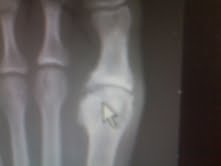
In Tibetan medicine, it is assumed that an injury often occurs in an already weakened part of the body. Another example of arthritis from the Western conventional medical healing tradition is rheumatoid arthritis or rheumatic arthritis.

For arthritis treatment of the fingers, you can contact us at any time.

In the image, you can see a rheumatoid arthritis inflammation of the metatarsophalangeal joints of the foot.
In rheumatoid arthritis, it is an autoimmune disease in which autoantibodies, some of which are even secreted by the affected cartilage cells themselves, are directed against the body’s own proteins. It is not clear what causes this behavior, but the result is that the body treats the joint tissue like a foreign invader. Immune cells invade the joint even though there is no tissue damage to repair. This reaction leads to chronic inflammation, which destroys bone and cartilage.
Another arthritic disease that has nothing to do with a previous injury is spondyloarthritis. Patients suffer from constant inflammation in the joints and at the sites where ligaments and tendons attach to the bones, even without a causative injury. This leads to a flood of enzymes and degradation processes as in osteoarthritis, but this is driven by other inflammatory proteins called cytokines.
As the enzymes erode the cartilage, the body attempts to stabilize smaller joints by fusing them together.
This process sometimes leads to outgrowths called bone spurs, which also cause severe stiffness and joint pain.
With so many factors causing arthritis, current treatments in Western medicine are tailored to combat specific symptoms rather than the underlying causes.
These range from M-ACT techniques, in which cells are taken from small pieces of cartilage to grow replacement tissue, to a technique called microfracture, in which surgeons drill small holes in the bone, allowing stem cells from the bone marrow to escape and form new cartilage.
As a last resort, people with atrophied cartilage may even undergo complete joint replacement, but apart from these drastic measures, the underlying reasons for autoimmune arthritis still pose a unique challenge for Western treatment methods. Scientists are making progress with therapies that block TNF-alpha, one of the main proteins that, according to Western conventional medicine, cause inflammation in rheumatoid arthritis. But even this approach only treats the symptoms of the disease and not the cause.
Arthritis Treatment in Tibetan Medicine
Our treatments at Umahaus focus on prevention, improvement of existing diseases, and resolution of chronic disorders after the actual cause is eliminated.
We treat patients in a more differentiated way than Western conventional medicine, which considers a treatment correct only if it has helped as many people as possible. Our therapies include nutrition, behavior, herbs and medicines, as well as manual and thermal applications. One and the same diagnosis can lead to even opposite treatments in Tibetan medicine, depending on the constitutional type, especially in arthritis. Depending on the type, arthritis can have different characteristics. In Tibetan medicine, three constitutional types and their mixed forms are assumed.
Which of the three constitutional types the patient tends toward is first determined during a detailed conversation, a pulse diagnosis, observation of the person, and after palpating the joint and other parts of the body. During the conversation, an attempt is made to determine not only the natural tendencies of the patient but also the possible immediate causes of any disorders. The patient’s diet and lifestyle play a role. The visual examination also includes examination of the tongue.
When interpreting all these diagnostic signs, the patient’s age is taken into account, as well as the season, since natural tendencies change depending on age and season. These diagnostic methods require great skill, much practice, and experience, but provide a lot of important information about the patient.
The three constitutional types consist of the light, emotional type Lung (Wind), the strong, assertive type Tripa (Fire), the large, grounded type Badkan (Phlegm), or a mixture of these three types.
You can learn more about the constitutional types and modern Tibetan medicine here.
Lung (Wind) is the dominant energy of the body and keeps the other two energies Tripa (Fire) and Badkan (Phlegm) in balance. Wind has expanding and cold properties. It is responsible for all movements inside and outside the body, from blood circulation to the movement of the limbs.
Wind characters are restless and elusive, as they are constantly in mental and often in physical motion. Wind types rarely have fever; on the contrary, their body temperature even tends to drop.
Disorders originate more frequently from Lung (Wind) than from the other two humors and have the unfortunate property of affecting the body most severely. Wind diseases are relatively easy to treat with warmth and grounding.
Tripa (Fire) represents digestive energy. A Fire type is impulsive and assertive. When all humors are in balance, this character has healthy self-confidence, but an excess can make such a person angry, know-it-all, and aggressive. This can be balanced by the cooling elements water and earth.
Badkan (Phlegm), also the phlegm composed of water and earth, is a cold energy that is identified with all watery components of the body, such as the elasticity of tissue (fascia), lymph, mucous membranes, etc. The kidney is the essential organ. If the phlegm finds no outlet, infections can break out more easily, as can inflammation. An excess of phlegm is treated with heat.
In their natural, healthy state, people tend to belong to either the Wind, Fire, or Phlegm type, but more often to a combination of two of these types (Wind-Fire; Wind-Phlegm; Fire-Phlegm). A disease arises when one or two of these energies are in excess or deficiency, or when their flow in the body is blocked. Such excesses or deficiencies arise due to a variety of conditions, including those related to diet, behavior, mental state, season, climate, life stage, and so on. Among the three constitutional types, Lung (Wind) has a more important status, as it can worsen any other imbalance in the body.
If the arthritis is characterized by (Lung) Wind, meaning hardness, dryness, and cold, then treatment is with the opposite, namely softness, moisture, and warmth. Nutritious, nourishing, and high-fat food, and above all rest, warmth, enjoyment, and relaxation.
Proper nutrition plays a particularly important role in psoriatic arthritis (psoriasis with joint inflammation), with or without skin involvement.
The Tripa Fire arthritis is characterized by heat and often triggers gout. For successful therapy, it is recommended to sweat a lot, drink plenty of fluids, avoid acidic foods, and cool the affected joint.
The Badkan Phlegm arthritis can be helped by avoiding sweet foods, more movement without straining the joints, much sweating, and an essential vibration therapy with the UMATI instrument. The patient can perform UMATI therapy in self-treatment or with a partner.
UMATI is a rod made of over 100 steel and copper rods which is already placed under tension during production so that it releases vibrations during treatment that quickly bring the basic energies of the person back into balance.
As an alternative, we cordially invite you to visit Umahaus.